Showing posts with label Henry Morton Stanley. Show all posts

Sunday, 20 March 2011

Henry Morton Stanley statue unveiled

A statue of Victorian journalist and explorer, Henry Morton Stanley was unveiled in Denbigh, North Wales, on March 17 . The life-size bronze portrays him at the moment he found fellow adventurer Dr David Livingstone - arm outstretched, hat by his side and presumably uttering some memorable words. Residents of the town voted in favour of commemorating its most famous son and £31,000 was raised to pay for sculptor Nick Elphick's statute.
Of course Stanley always claimed to be American but he was actually born John Rowlands and brought up in Denbigh's St Asaph workhouse. He emigrated to the US in 1859.

Not surprisingly, the statue has proved to be controversial. Many in the town are proud of the explorer and feel he's had a bad press, being misrepresented both by the Victorian establishment and latter day historians. However, at the unveiling of the statue, Selwyn Williams, a lecturer at Bangor University, representing
opponents of the memorial, told reporters: "Stanley was one of the cruellest Victorian expeditionary surveyors. Needless to say all the statutes of Stanley in Africa have been taken down a long time ago. They (Stanley and King Leopold II of Belgium) turned the Congo into the worst example of colonisation, brutal exploitation, enslavement and genocide in Africa. I'm sure most Welsh people share the view that Stanley's 'exploitation by warfare' in Africa was contemptible."

Tim Jeal, author of
Stanley: The Impossible Life of Africa's Greatest Explorer unveiled the statue and wrote about the day in the Daily Telegraph. And talking of Stanley statues, it's about a year ago since it was reported that there were moves afoot to restore a memorial to the explorer in Kinshasa, capital of the Democratic Republic of Congo.

Tuesday, 30 March 2010

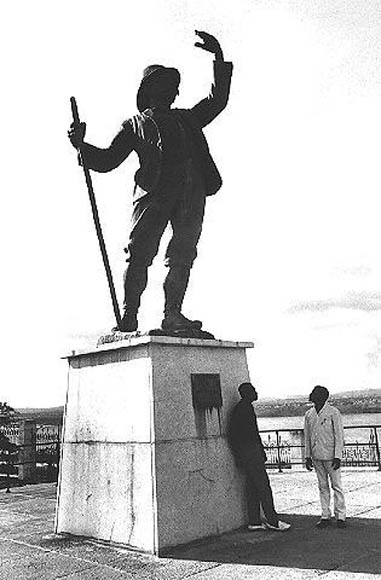
Statue of Henry Morton Stanley

Henry Morton Stanley, the British-born American explorer and journalist is famous for rescuing the Scottish missionary David Livingstone, and his part in the European colonisation of Africa. However, despite his considerable achievements as an explorer, Stanley's reputation has been severely tarnished by his association with the creation of the Congo Free State. This was a private colony set up by King Leopold II of Belgium in the Congo basin in the 1880s. For nearly 25 years the country was looted for its natural resources and became notorious for the way the locals were killed or mutilated in a brutal system of slave labour. Meanwhile, Leopold amassed a huge personal fortune.

For years a statue of Stanley looked out over Kinshasa, capital of the Democratic Republic of Congo, until it was pulled down in 1971. Now, according to the Independent, the British have launched a tender to restore the memorial. Tim Jeal, author of Stanley: The Impossible Life of Africa's Greatest Explorer, has responded to the article in which he claims the explorer is "portrayed as a monster."

In his book, Jeal attempted to rehabilitate Stanley's reputation. This he did, in part, using previously undisclosed archival material. For example, he writes that as a journalist, Stanley often exaggerated his fights with Africans to make his copy more exciting. In a note from July 1877 he claimed to have "fought 32 battles" and "destroyed 28 large towns" on the Congo, something that has often been used to prove his brutality. Jeal though, found nothing in the man's original diary to support this.

Thursday, 19 November 2009

Congo Free State

Travelling back to work after visiting the Hidden Histories exhibition, I spotted a letter in the Guardian drawing attention to the fact that "Today marks 100 years since the Archbishop of Canterbury led the great Congo demonstration that met on the steps of the Royal Albert Hall to call for justice in the Congo Free State."

The Congo Free State was a private colony set up by King Leopold II of Belgium in the Congo basin in the 1880s. For nearly 25 years the country was looted for its natural resources and became notorious for the way the locals were killed or mutilated in a brutal system of slave labour. Meanwhile, Leopold amassed a huge personal fortune.

Apart from the fact that the Royal Geographical Society is just around the corner from the Albert Hall, it is worth mentioning that the exhibition doesn't shy away from the ethics of exploration and Henry Morton Stanley's involvement with the Congo.

Following his success in 'finding' David Livingstone, in 1871, Stanley, the journalist, reinvented himself as an effective explorer discovering and charting central Africa's lakes and making a horrendous journey from east to west Africa. He was then employed by Leopold to help establish the new state and while he may not have been responsible for the horrendous crimes, Stanley's association with it was to leave his reputation severely tarnished.

As an aside, what went on in the country was fictionalised in Joseph Conrad's Heart of Darkness, centred on the evil trader Mr Kurtz, although there is debate as to whether or not this was modelled on Stanley.

One of those calling for justice in the Congo was the author Sir Arthur Conan Doyle as can be seen in this Manchester Guardian report from November 1 1909.